


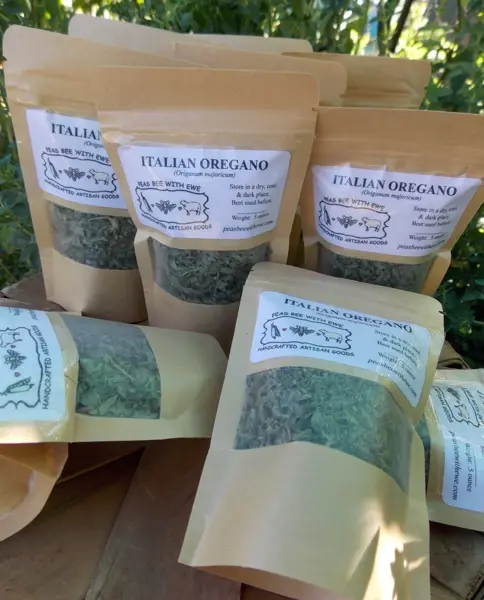

Oregano, Origanum majoricum, Italian Oregano
This oregano was lovingly and organically grown by me on our homestead in Arizona without herbicides, pesticides, or chemical treatments of any kind on the plant or in the soil.
This variety is a hybrid of two species, majoram (Origanum majorana) and wild oregano (Origanum vulgare). The seeds used to grow our oregano are organic and were purchased from a certified organic company. However, I am not certified as organic.
After I harvest the oregano, I dry it naturally without using heat to protect the nutrients and benefits of this herb.
DIRECTIONS FOR USE: Infuse in hot water for tea; use in cooking; or use in tinctures and oil infusions. You can also infuse as a facial steam, add to bathwater, or make potpourri with it.
HISTORY: “The Greeks and Romans knew and used oregano, but exactly which species it was is unclear. Perhaps it was Origanum vulgare, the common oregano that grows wild in the mountains of Greece. Oregano’s name means “joy of the mountain,” derived from the Greek oros, meaning “mountain,” and ganos, meaning “joy.” Perhaps this is why much later, in the sixteenth century, herbalist John Gerard recommended a decoction of the leaves to “easeth such as are given to overmuch sighing.” The Greeks made poultices from the leaves and placed them on sores and aching muscles. The ancient Roman scholar Pliny recommended oregano poultices for scorpion and spider bites. The great herbal written by the Greek physician Dioscorides in the first century A.D. describes more than one oregano as medicine.”
“As a cooking herb, oregano did not catch on at first. Looking through eighteenth-century recipes, it’s easy to find foods that use “sweet marjoram,” but chancing upon oregano in a recipe is more difficult. Some writers maintain that it wasn’t until World War II that the flavoring caught on. Servicemen returned from the Mediterranean with a taste for oregano (or at least a taste for Italian cooking), and once pizza embedded itself in the American consciousness, oregano became all-American.” – Rodale’s Illustrated Encyclopedia of Herbs.
Oregano enhances cheese and egg combinations, including omelets, frittatas, quiches, and savory flans. It adds dimension to yeast breads, marinated vegetables, roasted bell peppers, mushrooms, roasted and stewed beef, pork, poultry, game, onions, black beans, zucchini, potatoes, eggplant, and shellfish. Its flavor combines well with garlic, thyme, parsley, and olive oil.
Note: This product has not been evaluated or approved by the Food and Drug Administration to treat, cure, or prevent any disease. Please consult your healthcare professional before taking.
Expiration Date: The USDA defines spices as a shelf-stable product and, in the case of spices, they never truly expire. What occurs over time is that the flavor and potency of that spice wanes. Whole spices will stay fresh for about four years, while ground spices run between three and four years. For dried herbs, many will last from one to three years, but it varies depending on the type.
Half (.5) ounce
Packaging measures 3 ½” x 5 ½” when empty and laid flat.
Thank you for looking and Peas Bee with Ewe (Peace be with you).
Please check out my blogs at: https://www.peasbeewithewe.net/blog
Please check out my Facebook page at: https://www.facebook.com/PeasBeewithEwe/
Please check out my Pinterest page at: https://www.pinterest.com/peasbeewithewe/
Refund Policy
NO REFUNDS are offered due to potential health risk after being opened or handled by the consumer. This is to protect the health and safety of our customers. Thank you for understanding.